Spreadsheets are often the starting point for many businesses. They’re simple, flexible, and easy to adopt without any setup costs or training. In the early stages of a business, they work well enough to track sales, manage expenses, and organise basic operational data.
However, as a business grows, the very simplicity that once made spreadsheets useful can start to become a limitation. What used to feel efficient can slowly turn into a source of confusion, errors, and wasted time.
Here are some clear signs that your business may have outgrown spreadsheets.
One of the earliest warning signs is the existence of multiple versions of the same file circulating within the organisation. This usually starts small, but as different team members update and resend files, it becomes harder to track what the most accurate version actually is.
This often shows up in everyday business documents like quotations or invoices, where multiple versions start circulating and getting saved locally or forwarded across teams.
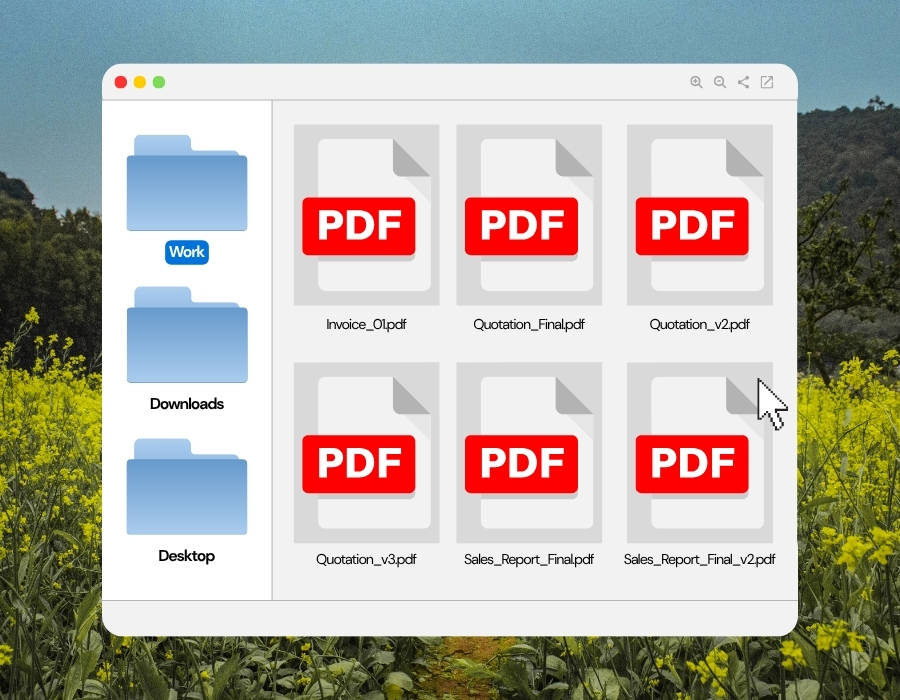
You might start seeing file names like:
At first glance, these seem harmless. However, over time, it becomes difficult to know which quotation was actually sent to a customer, which one was approved, and which version reflects the most updated pricing or terms. Small inconsistencies like these can quickly lead to miscommunication, especially when multiple departments are involved in the approval or sales process.
At this stage, teams may unknowingly be working off different versions of the truth. This creates confusion not just internally, but also externally when customers receive inconsistent or outdated documents.
Another common issue is the repetition of manual data entry across multiple spreadsheets. As businesses grow, different departments often begin maintaining their own files for similar or overlapping information. For example, sales, finance, and operations may each be tracking related data separately.
This creates unnecessary duplication of work. Employees may find themselves entering the same information multiple times, just in different formats or sheets. Not only does this take up time, but it also increases the risk of human error creeping into the system.
Reporting is another area where the limitations of spreadsheets become very obvious. When a business is small, generating reports is straightforward. But as data grows, compiling information often requires manual effort — copying, pasting, checking formulas, and cross-verifying figures across different files.
Instead of having instant access to insights, teams may spend hours just preparing the data. This delay means that decisions are often made based on outdated information rather than real-time business performance.
As complexity increases, errors also become more frequent and harder to detect. A single broken formula, incorrect input, or accidental deletion can affect entire reports or financial records. Unlike structured systems, spreadsheets do not always provide safeguards against these issues.
Over time, these small errors can compound and lead to larger business problems such as incorrect invoicing, inaccurate stock levels, or misleading financial reports.
Collaboration is another area where spreadsheets begin to struggle. While modern cloud tools have improved shared access, many businesses still face challenges when multiple people are editing or working on the same file.
This often leads to:
As teams grow, coordination becomes more important — and spreadsheet are not always designed for that level of collaboration.
Another clear sign is the lack of real-time visibility into business performance. Business owners and managers often need quick answers to questions like revenue status, outstanding invoices, or inventory levels. With spreadsheets, these answers are rarely available instantly.
Instead, someone usually needs to gather data from multiple files and compile it manually before any insight can be drawn. This slows down decision-making and can cause businesses to miss opportunities or react too late to issues.
In many SMEs, spreadsheets also create an over-reliance on specific individuals. There is often one person who “knows everything” about how the files are structured, how formulas work, and how reports are generated.
This creates a risk for the business. If that person is unavailable or leaves the company, critical processes may become difficult to manage. Knowledge becomes siloed instead of shared across the organisation.
Finally, a very practical sign is when administrative work starts consuming too much time. Instead of focusing on growth, sales, or customer service, employees spend large portions of their day updating files, correcting errors, and managing manual processes.
At that point, the spreadsheet is no longer just a tool — it becomes a workload in itself.
Spreadsheets are not “bad” tools — they are simply not designed to support complex, growing business operations. They work well up to a certain point, but beyond that, they can start to slow things down rather than support growth.
If your business is experiencing challenges such as version confusion, manual duplication, reporting delays, or lack of visibility, it may be a sign that your current system is reaching its limits.
Many businesses in Singapore reach this stage as they scale, and this is often when they begin exploring more integrated ways to manage their operations — from invoicing and finance to sales and reporting — within a single connected system.
At Zetta Solution, we work with SMEs to help them move beyond fragmented spreadsheets and manual processes, towards more streamlined and connected business operations through ERP and InvoiceNow-ready solutions. The goal is not just to digitise work, but to make day-to-day business processes clearer, faster, and easier to manage as the company grows.
Write to us today at sales@zetta-solution.com to find out more!
Image Source:
.png)