Let's be honest — the moment you first typed a question into an AI chatbot and got a coherent, human-sounding reply, something shifted. For many of us in the business technology world, that shift felt like standing at the edge of a cliff and realising the cliff had a perfectly good elevator.
Since ChatGPT burst onto the scene in November 2022, AI tools have gone from party tricks to boardroom agenda items. And now, with Anthropic's Claude rising as a serious contender, the question we hear most from our clients isn't "Should we use AI?" — it's "Which AI should we use?"
So we did the homework. Here's an honest, in-depth breakdown of ChatGPT vs Claude — what each does brilliantly, where each falls short, and most importantly, what it means for businesses running (or considering) custom ERP systems.
ChatGPT is built by OpenAI, the San Francisco-based lab originally co-founded by Elon Musk and Sam Altman. It runs on the GPT architecture — now in its fifth generation — and has become the world's most recognised AI assistant, boasting hundreds of millions of weekly active users as of 2026.
Claude, on the other hand, is built by Anthropic, a company founded in 2021 by former OpenAI researchers (including siblings Dario and Daniela Amodei) who wanted to take a more safety-first approach to AI development. Claude's design philosophy centres around something called "Constitutional AI" — a methodology that bakes ethical guidelines directly into how the model reasons and responds.
Think of it this way: if ChatGPT is the Swiss Army knife of AI — versatile, feature-rich, always ready — Claude is the precision scalpel. Each is exceptional. Each is designed with a different purpose in mind.
By 2026, both models have reached a level of capability where the raw performance gap has largely closed. That means choosing between them is less about which one is "smarter" and more about which one is better suited to your specific workflows. Here's how they compare across the dimensions that matter most:
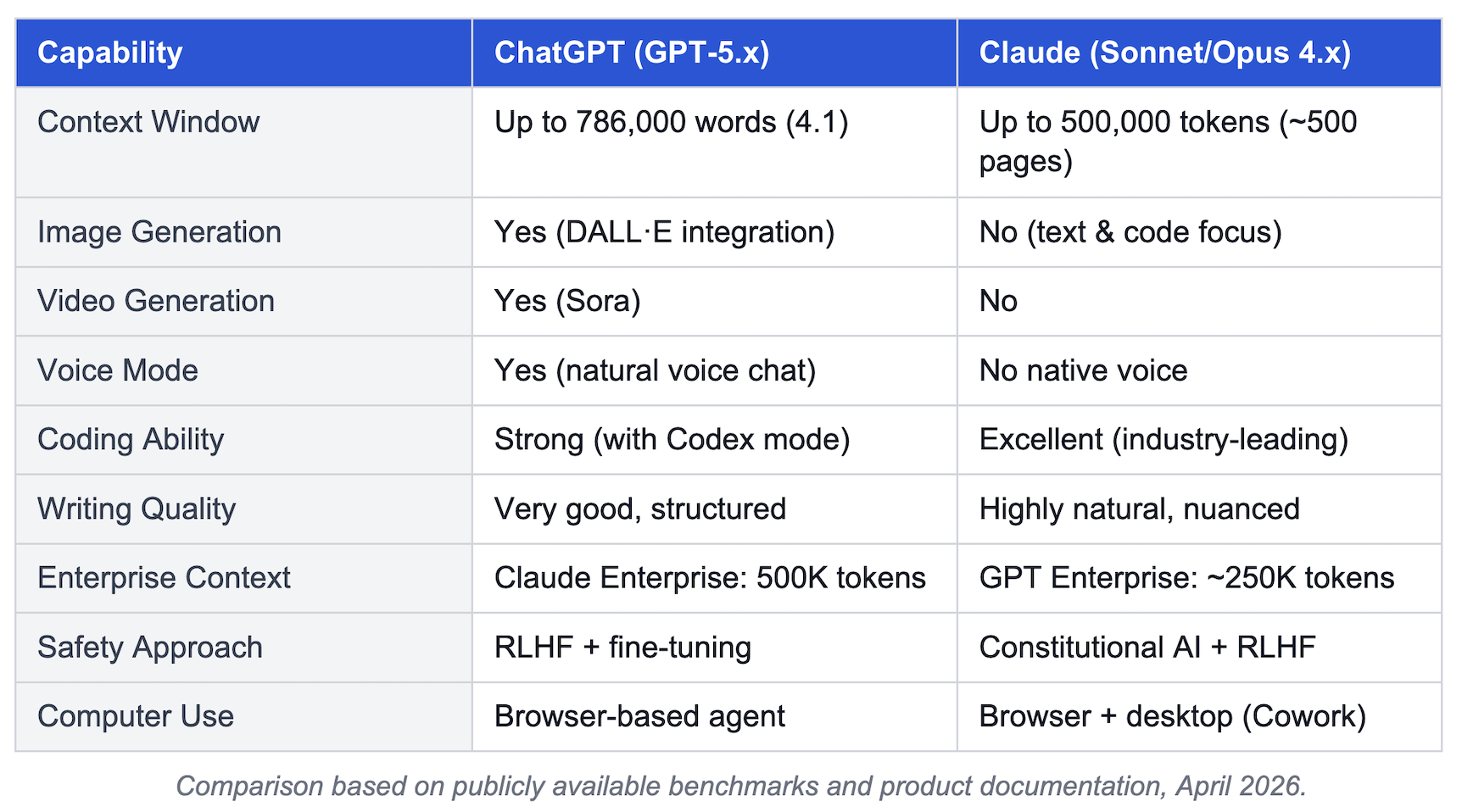
ChatGPT's greatest strength is its breadth. If you need an AI that can do a little bit of everything — generate an image for a marketing campaign, transcribe a voice meeting, write a product description, and then draft a Python script — ChatGPT is the more complete toolkit.
For businesses that need an all-in-one AI companion across many departments — from HR to marketing to customer support — ChatGPT's versatility is hard to beat.
Claude's strengths are narrower but deeper. If your use case involves complex, long-form reasoning, technical work, or producing content that genuinely reads like a human wrote it — Claude is in a different league.
For teams doing serious knowledge work — software development, financial analysis, contract review, or producing high-quality written deliverables — Claude's depth is hard to match.
Here's where it gets relevant for businesses like yours — or businesses like the ones we work with every day.
Custom ERP systems are increasingly being extended with AI capabilities. Whether it's automated data entry, intelligent reporting, natural language queries, or AI-assisted decision making, the choice of underlying AI model matters.
For ERP-Adjacent Use Cases, Here's Our Take:
The honest answer for most ERP environments: Claude for depth and precision, ChatGPT for breadth and multimodal tasks. Many enterprise teams are using both.
For those who prefer their decisions data-backed, here are some key benchmarks from 2025–2026:
The takeaway? The days of one model being clearly superior across the board are largely over. Both are exceptional. Your choice should come down to features and fit, not raw capability.
We'll be direct: there's no universal winner. But here's a practical framework we share with our clients:
Choose Claude if you:
Choose ChatGPT if you:
Consider both if you:
We're at an inflection point. AI tools like ChatGPT and Claude are no longer experimental — they're production infrastructure. The businesses that thrive in the next five years will be the ones that know not just that AI exists, but how to deploy the right AI for the right job.
At its core, this isn’t only about choosing between ChatGPT and Claude. As AI adoption grows, businesses will need to evaluate a wider ecosystem of tools based on their specific goals, workflows, and operational needs. The focus should be on identifying where intelligence can be augmented and integrating these tools into systems, like ERP platforms, in ways that help teams work more efficiently, scale faster, and create meaningful business impact.
That's what we do. Whether you're building a custom ERP from the ground up or looking to layer AI capabilities onto your existing systems, we'd love to talk about what that looks like for your business.
The best AI tool is the one your team will actually use — and the one that fits seamlessly into the systems they already depend on.
Talk to our team about custom AI-powered ERP solutions built for your industry.
[ Get in Touch ] [ Explore Our Solutions ]
References
Zapier: "Claude vs. ChatGPT: What's the difference?" (March 2026)
NexOS AI: "Claude vs ChatGPT: In-depth comparison" (2025)
Creator Economy: "ChatGPT vs Claude vs Gemini: Best AI for each use case" (June 2025)
Neontri: "ChatGPT vs Claude: Two Giants, Different Strengths" (2025)
IntuitionLabs: "Claude vs ChatGPT vs Copilot vs Gemini: 2026 Enterprise Guide" (2026)
G2: "Claude vs. ChatGPT: What I Found After 30 Days of Use" (August 2025)
.png)